Minnesota
Before statehood to the present
Dakota and Anishinaabe homelands, the rivers that shaped Minnesota's communities, and the Minnesotans who served from the Civil War through Korea.
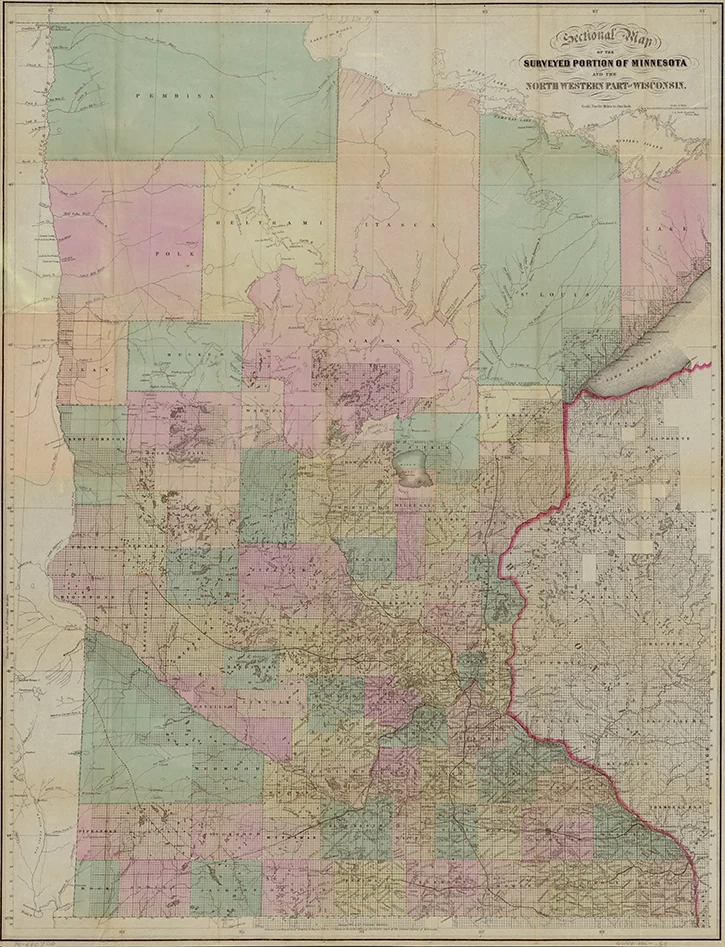
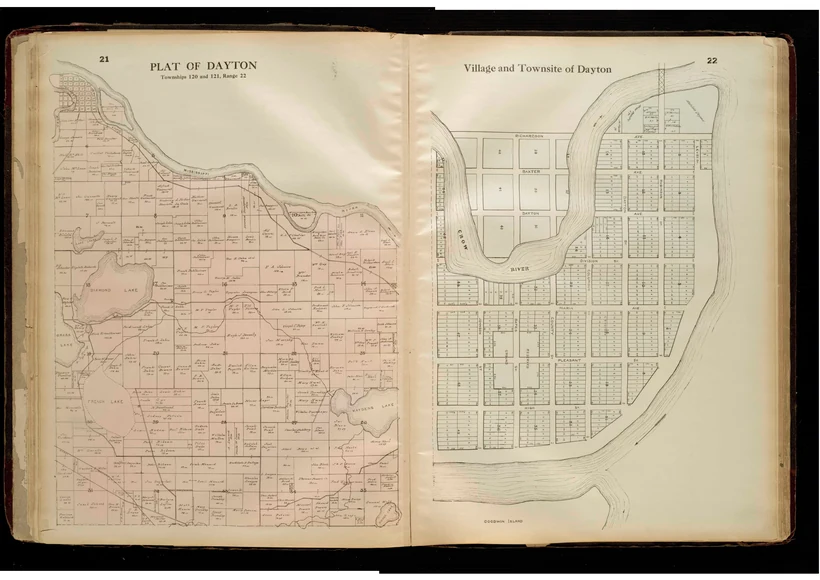
Joseph S. Sewall's sectional map records how surveyors divided the land into townships and sections in the early years of statehood.
Joseph S. Sewall · Library of Congress, Geography and Map Division · U.S. public domainHistory
Homelands, waterways, and statehood
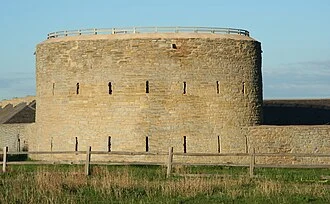
Dakota and Anishinaabe histories long precede Minnesota Territory. At Bdote, where the Minnesota and Mississippi rivers meet, Dakota people have long maintained a connection to the land and water. The U.S. Army constructed Fort Snelling above the confluence in the early 1820s.
Congress organized Minnesota Territory in 1849. The 1851 treaties at Traverse des Sioux and Mendota transferred millions of acres of Dakota land to the United States under pressure. Minnesota entered the Union on May 11, 1858. Today, Minnesota includes seven Anishinaabe reservations and four Dakota communities.
Two wars in the early years of statehood
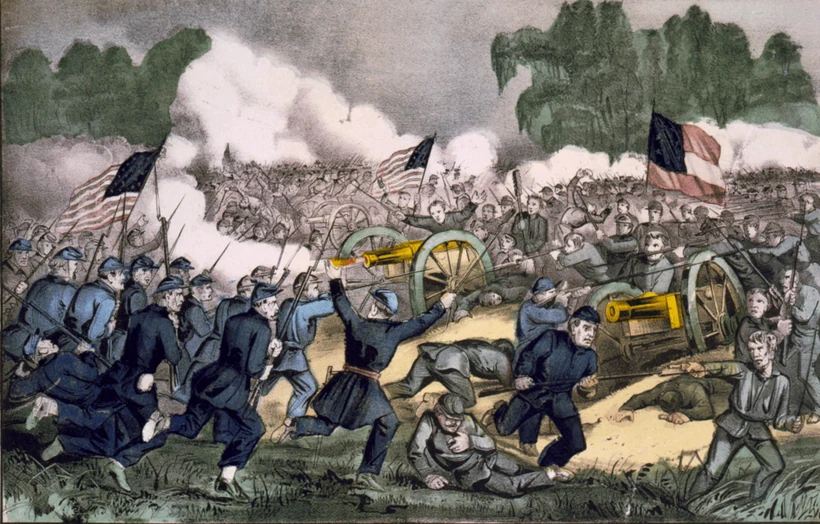
In 1861, the state reopened Fort Snelling to train volunteers. The First Minnesota Volunteer Infantry helped hold the Union line at Gettysburg on July 2, 1863. The Minnesota Historical Society also records 104 African American Minnesotans who volunteered for segregated U.S. Army units during the war.
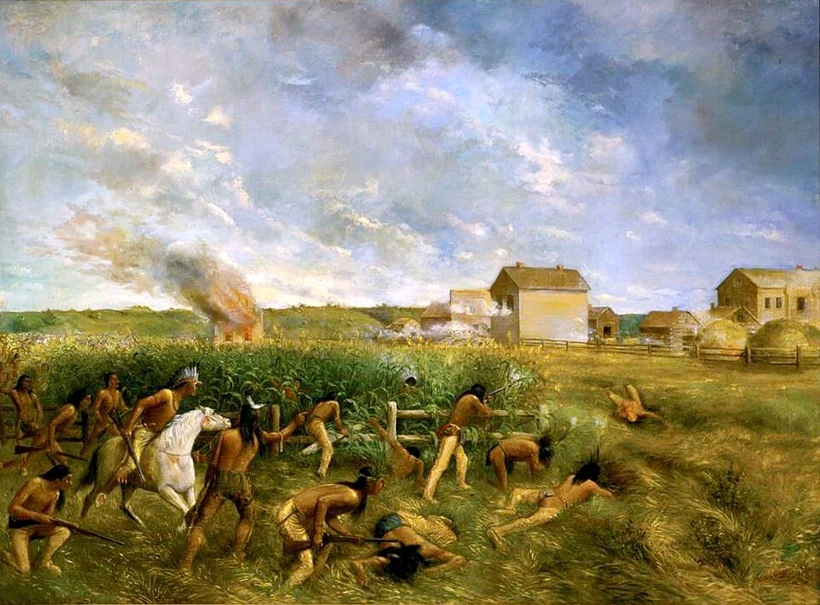
At home, hunger and broken treaties helped lead to the U.S.–Dakota War in August 1862. After the fighting, the U.S. Army forced many Dakota families into confinement below Fort Snelling. Thirty-eight Dakota men were executed at Mankato on December 26, 1862. In 1863, the federal government moved Dakota people from Minnesota by force.
Work, service, and remembrance
Water power at St. Anthony Falls helped make Minneapolis a milling center. The Capitol in Saint Paul opened in 1905. Civil War veterans carried Minnesota regimental flags from the old capitol to the new building that June.
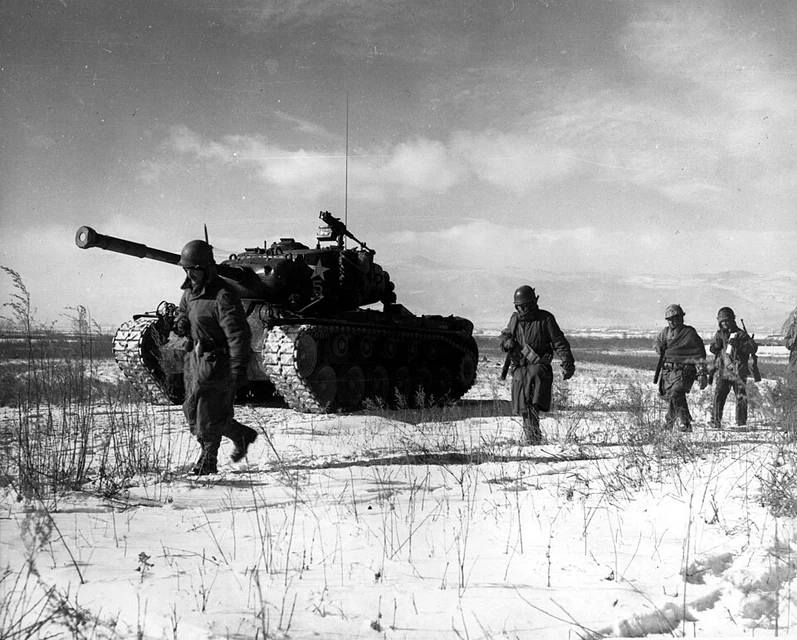
Minnesota Guard units served with the 42nd Division in World War I and the 34th Division in World War II. In 1951 the 47th Infantry Division entered federal service to train soldiers during the Korean War. Minnesota's Air Guard contributed pilots. The state memorial in Saint Paul lists 748 Minnesotans who died in the Korean War.
Timeline
Early 1820sFort Snelling rises above Bdote
The Army built the fort where the Minnesota and Mississippi rivers meet, a place of enduring significance to Dakota people.
1849–1851Territory and treaties
Congress organized Minnesota Territory in 1849. Two 1851 treaties transferred much of the Dakota homeland to the United States.
May 11, 1858Minnesota becomes a state
Congress admitted Minnesota to the Union as the 32nd state.
1862–1863War, confinement, and expulsion
After six weeks of fighting, the U.S. Army confined Dakota families at Fort Snelling. The December executions at Mankato were followed by forced expulsions in 1863.
July 2, 1863First Minnesota at Gettysburg
The regiment charged to buy time for Union reinforcements. Only 47 of the 262 members present that morning answered roll that evening.
1905A new State Capitol
Cass Gilbert's Capitol opened on January 2. Veterans carried regimental flags to the building in June.
1951The Guard mobilizes during the Korean War
The 47th Infantry Division trained soldiers for wartime service. Minnesota's Air Guard also contributed pilots.
September 18, 1998Minnesota dedicates its Korean War memorial
The Capitol Mall memorial in Saint Paul uses names, sculpture, and engraved paving stones to tell the story of the war.
Images and records
MapMinnesota in the 1860s
Joseph S. Sewall's sectional map records how surveyors divided the land into townships and sections in the early years of statehood.
Joseph S. Sewall · Library of Congress, Geography and Map Division · U.S. public domain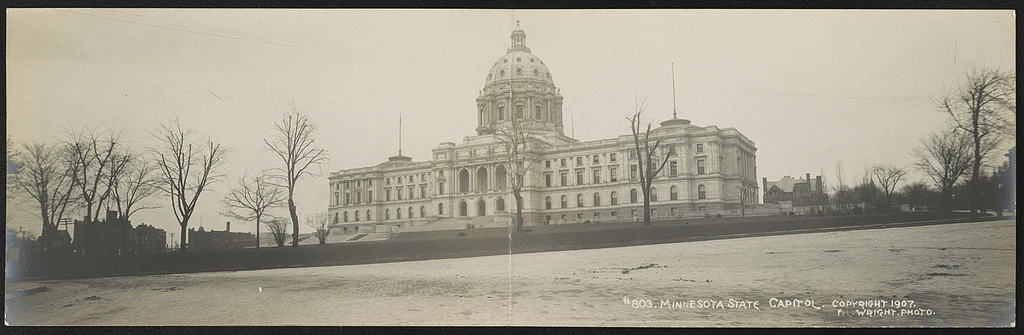
PhotographThe State Capitol around 1907
F. L. Wright's panoramic postcard shows the Capitol and grounds shortly after the building opened.
F. L. Wright · Library of Congress, Prints and Photographs Division · No known restrictions on publication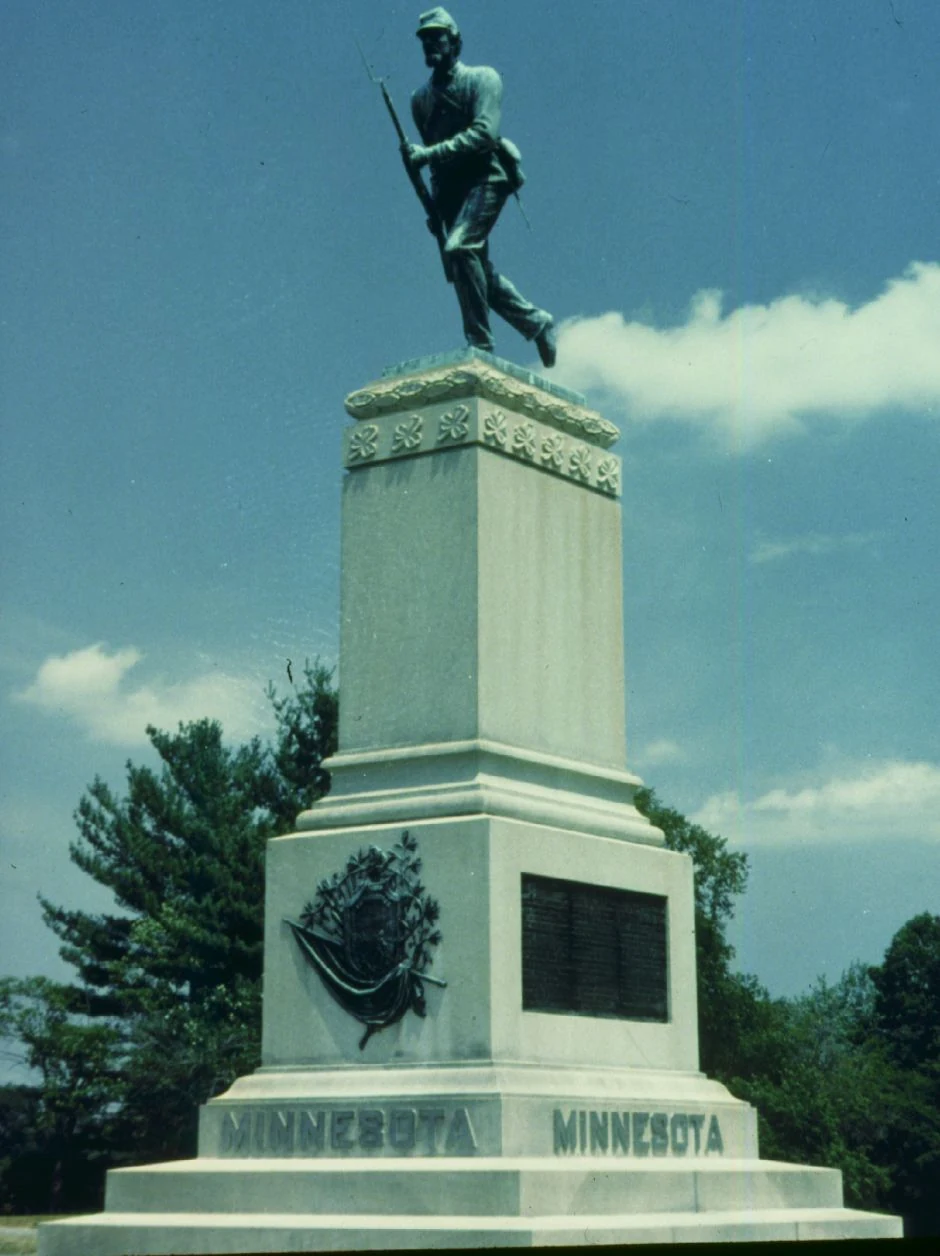
PhotographFirst Minnesota at Gettysburg
The battlefield monument commemorates the First Minnesota Volunteer Infantry's service at Gettysburg.
National Park Service · Gateway Arch National Park reference collection · U.S. public domain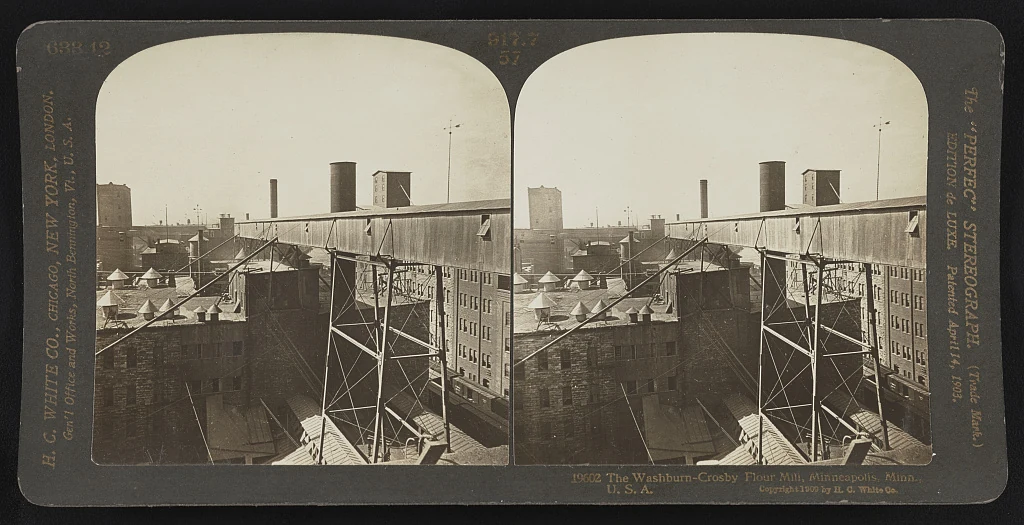
PhotographWashburn-Crosby flour mill, 1909
A two-view stereograph shows the Minneapolis milling complex near St. Anthony Falls.
H.C. White Co. · Library of Congress, Prints and Photographs Division · No known restrictions on publicationRelated history
Sources
-
Indigenous history · Minnesota Historical Society
The land, water, and language of the Dakota
A Dakota perspective on Minnesota's waterways, place names, and the persistence of Dakota culture.
-
State guide · Minnesota Indian Affairs Council
American Indian nations in Minnesota
Identifies seven Anishinaabe reservations and four Dakota communities.
-
Place history · National Park Service
The Mississippi and Minnesota River Confluence
Explains the importance of the confluence to Dakota people.
-
Historic site timeline · Minnesota Historical Society
Historic Fort Snelling timeline
Covers the military post, the Civil War, and its twentieth-century role.
-
Founding document · Minnesota Secretary of State
Organic Act of 1849
The 1849 act established Minnesota Territory.
-
Treaty history · Minnesota Historical Society
Minnesota treaties
Includes the 1851 Dakota treaties at Traverse des Sioux and Mendota.
-
Founding documents · Minnesota Secretary of State
Minnesota founding documents
Includes the admission of Minnesota as a state on May 11, 1858.
-
War timeline · Minnesota Historical Society
The U.S.–Dakota War of 1862 timeline
Includes treaty violations, the war, forced marches, executions, and expulsion.
-
Historic site history · Minnesota Historical Society
The U.S.–Dakota War and Fort Snelling
Details the confinement of Dakota families and the government's 1863 expulsions.
-
Audio and transcripts · Minnesota Historical Society
Mni Sota Wakpa stories and reflections
Voices and perspectives on the Minnesota River Valley and the U.S.–Dakota War.
-
Guard timeline · Minnesota National Guard
Minnesota National Guard milestones
Covers the First Minnesota, World War I, World War II, the 47th Infantry Division, and the Air Guard.
-
Military history · Minnesota Historical Society
Fort Snelling in the Civil War
Documents training at the fort and Minnesotans who served in U.S. Colored Troops.
-
Industrial timeline · Minnesota Historical Society
Mill City Museum history timeline
The Washburn mills and the growth of the St. Anthony Falls milling district.
-
Historic site timeline · Minnesota Historical Society
Minnesota State Capitol timeline
The 1905 opening and Civil War veterans' transfer of flags.
-
Memorial guide · Minnesota Capitol Area Architectural and Planning Board
Capitol Mall memorials and monuments
Describes the Minnesota Korean War Veterans Memorial, its dedication, design, and 748 names.
- Memorial guide · Minnesota Department of Veterans Affairs Minnesota Korean War Veterans Memorial
-
Historic map · Library of Congress
Sectional map of Minnesota and northwestern Wisconsin
Joseph S. Sewall's 1860s map. The Library of Congress exhibition includes an enlarged scan.
-
Historic photograph · Library of Congress
Minnesota State Capitol postcard
F. L. Wright, c. 1907. Library of Congress reports no known publication restrictions.
-
Historic photograph · Library of Congress
The Washburn-Crosby flour mill
H.C. White Co. stereograph, 1909. Library of Congress reports no known publication restrictions.
-
Memorial photograph · National Park Service
First Minnesota Monument
NPGallery identifies the image as public domain.
Veteran roster
Service references come from the wall inscriptions and approved public profiles.
2 veterans
| Veteran | Rank or rating | Military unit | Service period | Decorations, bases and places |
|---|---|---|---|---|
| Gerald O. Lehn | Staff Sergeant (U.S. Army) | — | Korean War era, according to family recollections. Exact service dates are open. Korean War |
Fort Sill Cambridge, Minnesota Minnesota |
| Neil McNeil | — | 9th Minnesota Volunteer Infantry | August to September 1862, the period documented for his civilian volunteer service. Battle of Acton Neil McNeil pension act U.S.–Dakota War of 1862 |
Cleveland, Ohio Dayton, Minnesota Minnesota Saint Paul, Minnesota |