Staff Sergeant (U.S. Army)
1920–1948 and 1958–present
Staff sergeant is the U.S. Army noncommissioned officer rank at pay grade E‑6 today. Its three chevrons and one curved bar have appeared in different Army rank systems over the past century.
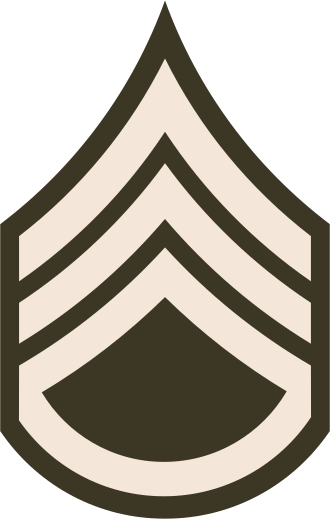
Three chevrons sit above one curved bar, also called a rocker. The Army uses this insignia for pay grade E-6 today.
Army insignia graphic · Wikimedia Commons · Public domainHistory
Leadership at squad level
An Army staff sergeant often leads a squad of eight to sixteen soldiers and may supervise one or more sergeants. Staff sergeants train soldiers in their jobs, prepare them for unit missions and enforce standards. Their exact duties depend on the unit and assignment.
The abbreviation is SSG. Today it sits above sergeant and below sergeant first class. A chevron is one of the upward-pointing stripes. The curved bar beneath them is called a rocker.
How the same chevrons changed meaning
Staff sergeant was among the seven standard Army enlisted grades established after World War I. The War Department’s 1945 pay manual lists staff sergeant in its Third Grade, which also included technician third grade.
The Army changed the enlisted structure and insignia in 1948. It reassigned the three chevrons and one rocker to sergeant. The 1955 grade table called E‑6 sergeant first class. When the Army added E‑8 and E‑9 in 1958, it restored the staff sergeant title at E‑6. Some soldiers were allowed to keep their previous E‑6 or E‑7 titles until June 1962.
Timeline
1920The Army standardizes seven enlisted grades
The new structure reduces the many earlier rank and specialty distinctions to seven grades. Staff sergeant is one of the titles in the new structure.
January 1945The wartime manual lists staff sergeant in Third Grade
The Army pay manual puts staff sergeant and technician third grade in the same pay grade. It lists separate titles for each.
Staff Sergeant (World War II Army)View World War II staff sergeant insignia
1948Three chevrons and a rocker are reassigned
A new rank and insignia system gives sergeant the previous staff sergeant pattern. The Army also issues smaller chevrons.
August 1955The regulation lists sergeant first class at E‑6
Army Regulation 600‑15 calls E‑6 sergeant first class. The Army still has seven enlisted pay grades.
June 1, 1958Staff sergeant returns at E‑6
The Army adds two pay grades and revises its titles. Staff sergeant is now E‑6, and sergeant first class is E‑7 under the new structure.
1958–1962Some soldiers retain their former titles
The August 1958 amendment lets soldiers who already held E‑6 or E‑7 on May 31 use their earlier titles until June 30, 1962, unless promoted or reduced in grade.
1971The Army establishes a system for NCO education
The Noncommissioned Officer Education System formalizes progressive professional education. Courses teach junior and senior enlisted leaders skills for responsibilities at different levels.
Compare today’s Army sergeant insignia
-
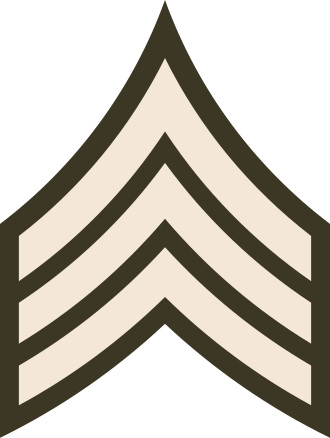 Sergeant · E‑5
Three upward-pointing chevrons. Sergeants typically lead a team or section.
-
Staff Sergeant · E‑6
Three chevrons over one rocker. Staff sergeants typically lead a squad.
-
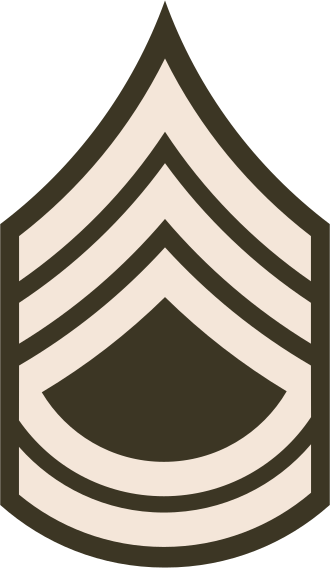 Sergeant First Class · E‑7
Three chevrons over two rockers. Sergeants first class commonly advise platoon leaders.
Images and records
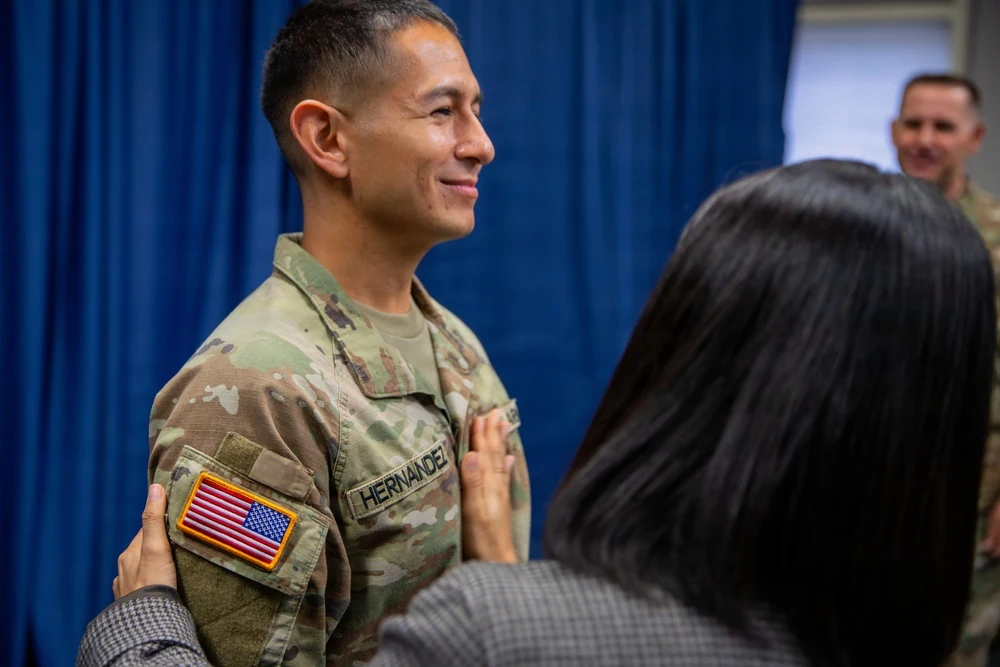
PhotographAn Army staff sergeant promotion ceremony
Matthew Hernandez is pinned with his new rank at Joint Base Myer–Henderson Hall in Virginia on November 25, 2025.
Sgt. 1st Class Gabriel Bacewicz / U.S. Army, via DVIDS · DVIDS identifies the photograph as public domain
InsigniaModern Army staff sergeant insignia
Three chevrons sit above one curved bar, also called a rocker. The Army uses this insignia for pay grade E-6 today.
Army insignia graphic · Wikimedia Commons · Public domain
InsigniaWorld War II staff sergeant insignia
The Army’s World War II system placed staff sergeants in the third enlisted grade. The badge also had three chevrons and one rocker.
Keenan Tims and contributors · Wikimedia Commons · Public domainRelated history


Sources
-
Official rank guide · U.S. Army
U.S. Army ranks
Current ranks, duties and where each rank fits in an Army unit.
-
Official insignia guide · U.S. Department of Defense
U.S. military rank insignia
A branch-by-branch comparison of rank and pay grade.
-
Official training guide · U.S. Army Center for Army Lessons Learned
Army rank chart
Illustrates the Army’s three adjacent NCO insignia.
-
Primary legislation · U.S. Government Publishing Office
National Defense Act amendments, June 4, 1920
Section 4b gives the seven new pay grades and reorganization context.
-
Official history · Army University Press
A Brief History of the Noncommissioned Officer and Professional Development
Explains the seven interwar titles and the evolution of professional education.
-
Official illustrated history · U.S. Army Center of Military History
The Noncommissioned Officer: Images of an Army in Action
The chevrons appendix traces the 1920, 1948 and 1958 changes.
-
Primary military manual · U.S. Government Publishing Office
War Department Army Pay Tables, January 1945
TM 14‑509, pages 6 and 11, identifies the wartime Third Grade.
-
Official illustrated reference · U.S. Army Center of Military History
Survey of U.S. Army Uniforms, Weapons and Accoutrements
Shows how Army uniform and chevron patterns changed.
-
Primary government decision · U.S. Government Accountability Office
1955 and 1958 enlisted grade tables in B‑143397
Reproduces the before-and-after tables and the provision for retaining earlier titles.
-
Primary legislation · U.S. Government Publishing Office
Military Pay Act of 1958
The law establishing additional enlisted pay grades.
-
Official history · U.S. Army
Army NCO History, Part 8
Traces the modern system of noncommissioned officer education from 1971.
- Official photograph · Defense Visual Information Distribution Service Staff Sgt. Hernandez Promotion Ceremony
- Public-domain illustration · Wikimedia Commons Army staff sergeant service uniform badge
- Public-domain illustration · Wikimedia Commons World War II Army staff sergeant badge
Veteran roster
Service references come from the wall inscriptions and approved public profiles.
15 veterans