Korean War
June 25, 1950 – July 27, 1953
North Korean forces invaded South Korea in June 1950. South Korea and a United Nations coalition led by the United States fought North Korea, which was joined by Chinese forces. Three years of fighting and displacement ended in a military armistice that established the Korean Demilitarized Zone.
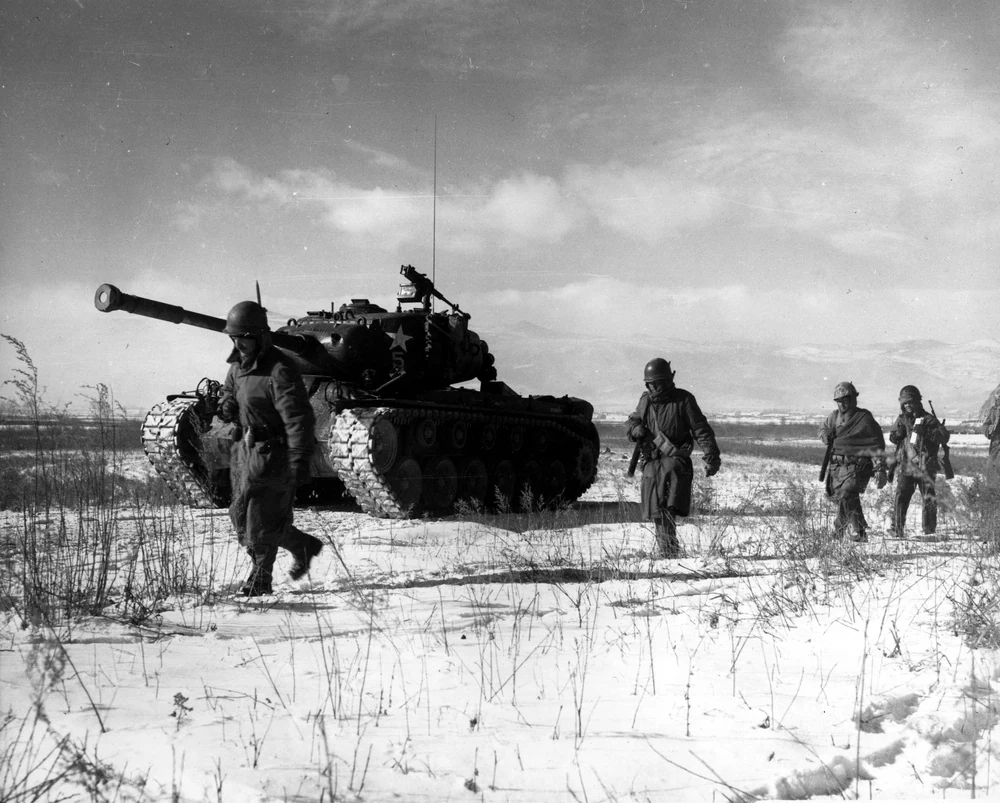
A column of the U.S. 1st Marine Division moves through Chinese lines during the Chosin Reservoir breakout in late 1950.
Cpl. Peter McDonald, U.S. Marine Corps, via DVIDS · Public domainHistory
From occupation to war
Japanese colonial rule ended in 1945. The United States accepted the surrender of Japanese forces south of the 38th parallel and the Soviet Union did so in the north. By 1948, separate governments had formed in Seoul and Pyongyang, and each claimed authority over Korea.
After North Korea invaded on June 25, 1950, the UN Security Council called for withdrawal and recommended that member states assist South Korea. A July resolution recommended a unified command under the United States.
Front lines and civilian lives
South Korean and UN forces held the perimeter around the southeastern port of Busan in August. A September amphibious landing at Incheon threatened North Korean supply routes and opened the way to Seoul. As UN forces advanced north, Chinese troops entered the fighting. The November attack near Chosin Reservoir forced U.S. Army and Marine units to fight their way south.
Busan served as a provisional capital and took in displaced families. Homes built by refugees in Ami-dong remain part of the city’s wartime heritage. In December, the UN Command evacuation moved troops and tens of thousands of Korean civilians out of northeastern ports.
Mobilization, loss, and remembrance
Minnesota’s National Guard was called into federal service in January 1951. The 47th Viking Infantry Division trained at Camp Rucker, Alabama, and many members were reassigned as replacements in Korea or Germany.
Armistice talks opened in 1951 while combat continued. In July 1953, military delegates agreed to a ceasefire and a four-kilometer-wide demilitarized zone. The agreement called for a later political settlement.
The Department of Veterans Affairs records 36,574 U.S. deaths in the theater, including 33,739 battle deaths. The Korean War Veterans Memorial in St. Paul commemorates Minnesotans who died. Veterans’ interviews and UN reconstruction records show how service and displacement shaped lives beyond the front.
Timeline
1945–1948Occupation zones become separate states
After Japan surrendered, the United States and Soviet Union occupied zones south and north of the 38th parallel. Governments formed in Seoul and Pyongyang in 1948.
June 25–July 7, 1950North Korea invades
North Korean forces crossed the 38th parallel on June 25 and took Seoul by June 28. The UN Security Council called for withdrawal, recommended assistance to South Korea, and recommended a unified command.
July–August 1950From Osan to the Pusan Perimeter
Task Force Smith fought the first U.S. ground action near Osan on July 5. In August, South Korean and UN forces defended the approaches to Pusan, now Busan, while refugees sought shelter there.
September 15, 1950South Korean and U.S. forces land at Inchon
Landing craft worked with narrow tide windows to put troops ashore at Inchon, now Incheon. The operation put pressure on North Korean supply routes and opened a way toward Seoul.
October–December 1950Chinese intervention and the withdrawal south
Chinese forces entered combat in late October and struck U.S. Army and Marine units near Chosin Reservoir on November 27. In December the evacuation from northeastern ports carried out troops and tens of thousands of civilians.
January 1951Minnesota Guard units mobilize
The Minnesota National Guard was called into federal service. The state’s 1951 legislative manual records that the 47th Infantry Division trained at Camp Rucker, Alabama, and the 109th Transportation Truck Battalion at Camp McCoy, Wisconsin.
February 13–15, 1951U.S. and French troops hold Chip’yong-ni
The U.S. 23rd Infantry and attached French Battalion defended the crossroads for three days until the Chinese force withdrew. The battle took place during the first UN counteroffensive.
July 10, 1951Armistice talks open at Kaesong
Military delegates began substantive talks at Kaesong. Negotiations later moved to Panmunjom, while fighting continued and the sides debated how prisoners would be repatriated.
July 27, 1953The ceasefire begins
Military delegates signed the armistice at Panmunjom at 10 a.m. The ceasefire took effect at 10 p.m. The agreement established a buffer zone and procedures for prisoner repatriation.
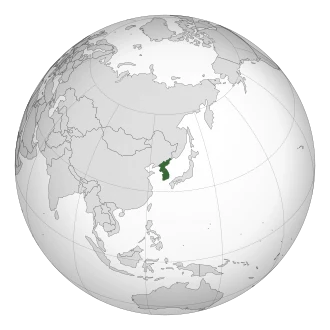
Korean PeninsulaView First page of the Korean Armistice Agreement
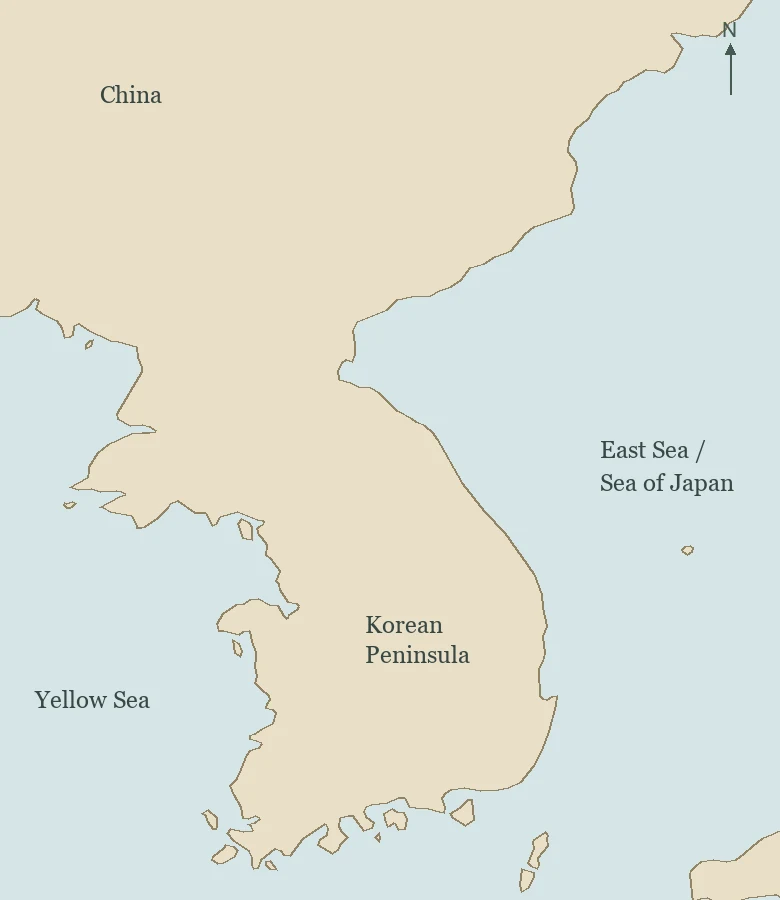
Places on the map
Choose a number or a place name. Markers show approximate locations.
-
1. Changjin (Chosin) Reservoir
In late November 1950, Chinese forces attacked U.S. Army and Marine units near this mountain reservoir. The troops withdrew toward the coast.
See this event on the timeline -
2. Panmunjom
Military delegates signed the 1953 armistice here. It set a military demarcation line and demilitarized zone.
See this event on the timeline -
3. Seoul
South Korea’s capital fell to North Korean forces in June 1950. Control changed repeatedly during the war.
See this event on the timeline -
4. Incheon (Inchon)
South Korean and U.S. forces landed at this port in September 1950 and advanced toward Seoul.
See this event on the timeline -
5. Busan (Pusan)
The southeastern port anchored the 1950 defensive perimeter and became a provisional capital and refuge for displaced Koreans.
See this event on the timeline
Images and records
PhotographBreakout from Chosin Reservoir
A column of the U.S. 1st Marine Division moves through Chinese lines during the Chosin Reservoir breakout in late 1950.
Cpl. Peter McDonald, U.S. Marine Corps, via DVIDS · Public domain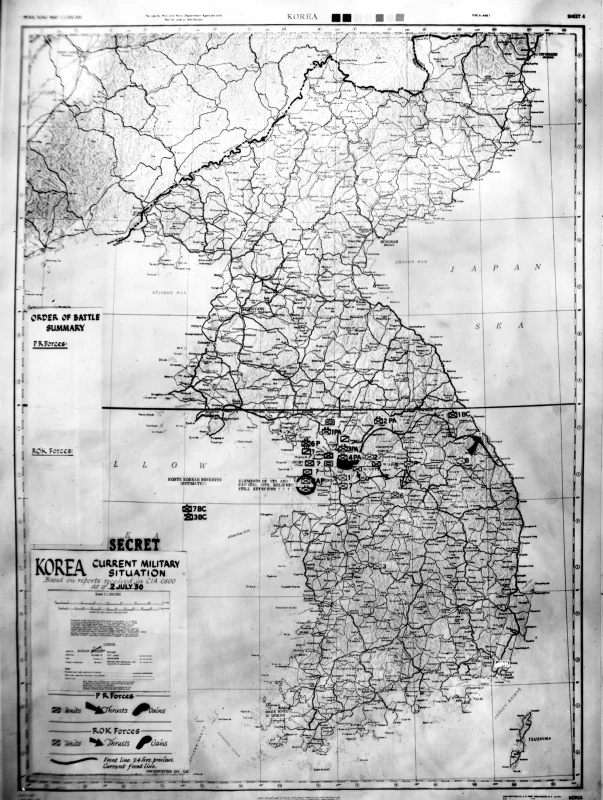
MapA map from the first week of the war
This map, dated July 2, 1950, records how the military situation was presented a week after North Korean forces crossed the 38th parallel.
Harry S. Truman Library & Museum, accession 63-76 · Public domain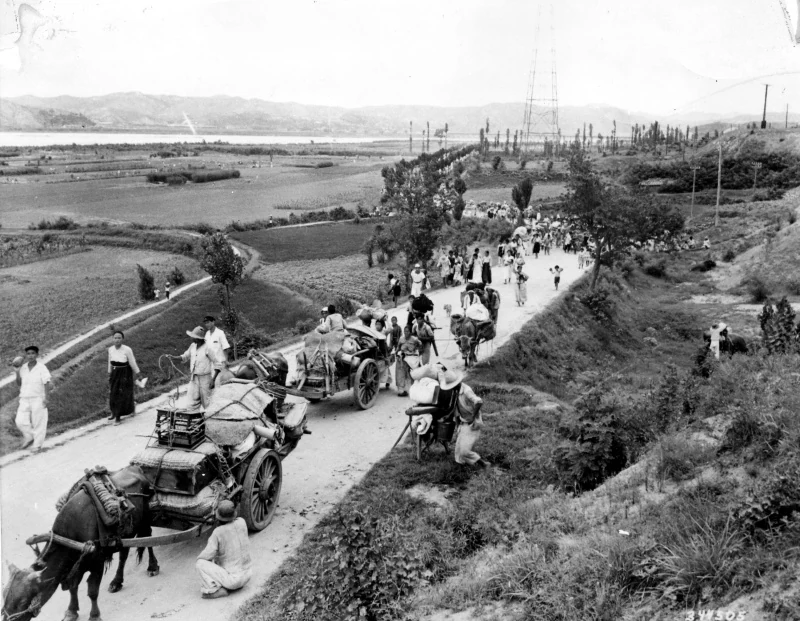
PhotographCivilians evacuate near Pohang
Korean civilians head south on August 12, 1950, after the South Korean Army ordered an evacuation near Pohang.
U.S. Army, Harry S. Truman Library & Museum, accession 67-7417 · Public domain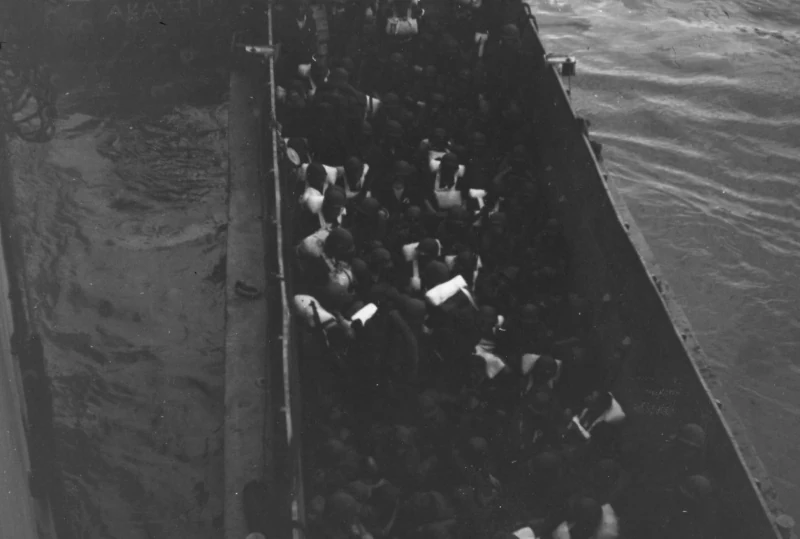
PhotographSouth Korean Marines prepare for the Inchon assault
South Korean Marines prepare to go ashore at Inchon on September 15, 1950. The photograph was taken from USS Pickaway.
U.S. Army, Harry S. Truman Library & Museum, accession 2007-674 · Public domain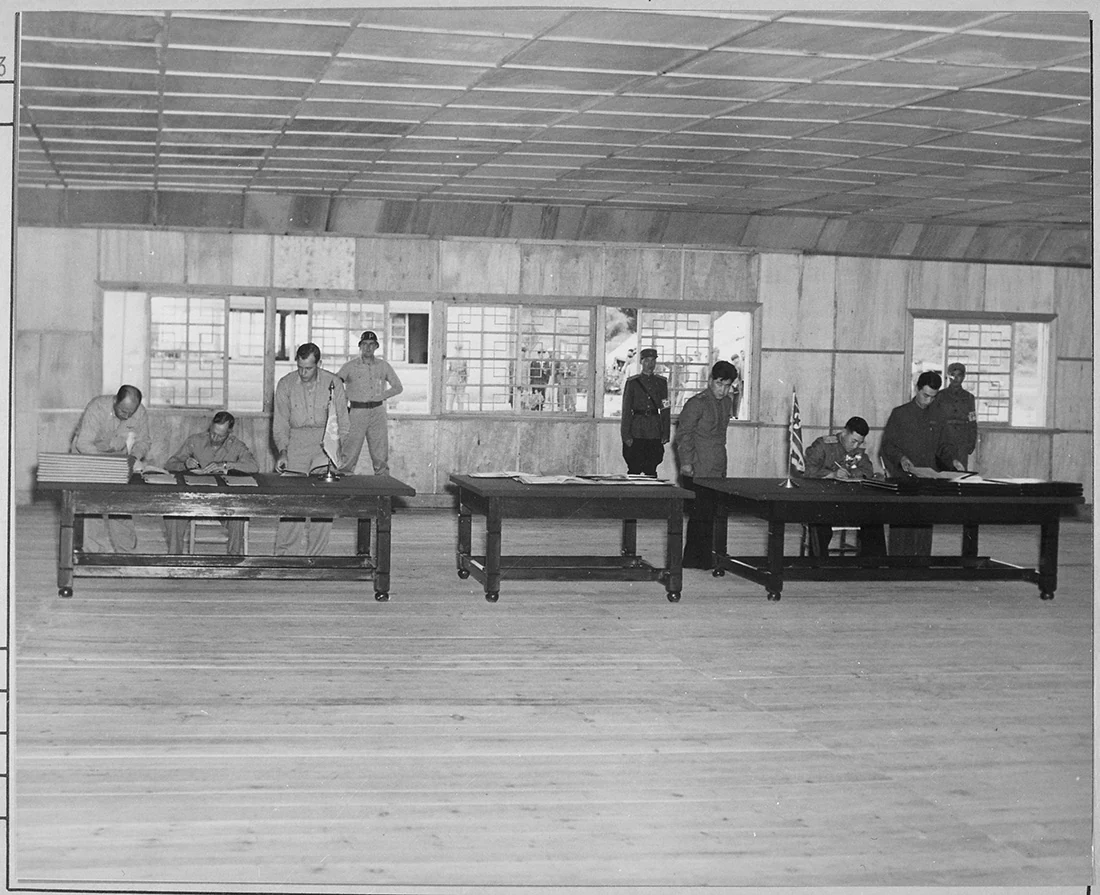
PhotographArmistice delegates at Panmunjom
Lt. Gen. William K. Harrison Jr., at left, and Gen. Nam Il, at right, sign the military armistice on July 27, 1953.
U.S. Navy, U.S. National Archives, 80-G-625728 · Public domain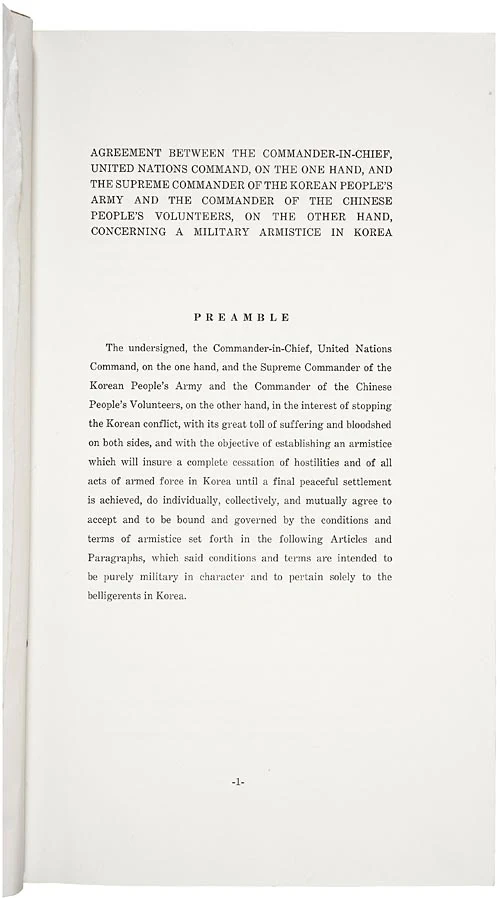
DocumentFirst page of the Korean Armistice Agreement
The agreement established a military demarcation line, a demilitarized zone, and a commission to supervise the truce. The National Archives provides all pages and a transcript.
U.S. National Archives, Record Group 11, item 5730903 · Public domainRelated history

Sources
-
Official history · U.S. Army Center of Military History
Korean War campaigns
Campaign summaries and inclusive dates.
-
Official history · U.S. State Department, Office of the Historian
The Korean War and the U.S.–Japan security relationship
Diplomatic background and the division after World War II.
-
Archival guide · Library of Congress
South Korean laws after World War II
Documents of the U.S. military government and the formation of two states.
-
Primary documents · United Nations Security Council
Security Council resolutions 82, 83, and 84
Read the June 25, June 27, and July 7 resolutions in the 1950 index.
-
Official history · U.S. Army Center of Military History
Korean War, Phase 1: UN Defensive
Opening chronology, first U.S. ground action at Osan, and the Pusan Perimeter.
-
Official history · U.S. Army Center of Military History
Korean War, Phase 3: Chinese Intervention
Chosin Reservoir fighting, the withdrawal, and a campaign map.
-
Official history · U.S. Army Center of Military History
Korean War, Phase 4: UN Counteroffensive and Chinese Spring Offensive
February 1951 fighting at Chip’yong-ni and the operations that followed.
-
Official timeline · United Nations Command
1950–1953: Korean War
Multinational participation and the December 1950 evacuation.
-
Official exhibit · Busan Metropolitan City
Busan as the Wartime Capital
Korean civilian, government, and refugee history in Busan.
-
Official exhibit · UNESCO World Heritage Centre
Busan wartime capital sites and displaced families
A surviving neighborhood where displaced families made homes.
-
Atlas · U.S. Military Academy Digital History Center
Korean War campaign maps
Campaign maps from the initial withdrawal through the armistice talks.
-
Official history · Minnesota National Guard
Minnesota National Guard milestones
The January 1951 mobilization and the role of the 47th Division.
-
Primary document · Minnesota Legislative Reference Library
1951 Minnesota Legislative Manual
The Military Affairs section records where Minnesota units were training.
-
Primary documents · U.S. State Department, Office of the Historian
Foreign Relations of the United States, 1951: Korea and China
Editorial note documents the opening of substantive talks at Kaesong.
-
Primary document · U.S. National Archives
Korean Armistice Agreement
Read the original pages and transcript, including the terms of the demilitarized zone.
-
Official history · U.S. National Archives
Korean War Armistice Agreement, 1953
Negotiations and signing. Use the original agreement or the photo catalog for the signing date.
-
Official statistics · U.S. Department of Veterans Affairs
America’s Wars: Korean War
U.S. battle deaths, other deaths in theater, and non-mortal woundings.
-
Memorial · Minnesota Department of Veterans Affairs
Korean War Veterans Memorial
Minnesota’s state memorial has a paved chronology and the names of Minnesotans who died.
-
Oral histories · Library of Congress Veterans History Project
Korean War: Serving Our Voices
Listen to or read veterans’ firsthand accounts.
-
Digital collection · Harry S. Truman Library & Museum
The Korean War and Its Origins
Presidential papers, diplomatic records, and military documents.
-
Digital exhibit · United Nations Archives
United Nations Korean Reconstruction Agency
A timeline, videos, and photo galleries of civilian life and rebuilding.
-
Archival index · U.S. National Archives
Korean War casualty lists by state
Names are indexed by home of record, with scope and date ranges on the page.
-
Archival map · Harry S. Truman Library & Museum
Map of Korea: Current Military Situation
Accession 63-76, July 2, 1950.
-
Archival photograph · Harry S. Truman Library & Museum
Refugees in Korea
U.S. Army photograph 67-7417, August 12, 1950.
-
Archival photograph · Harry S. Truman Library & Museum
Korean Marines during Inchon assault
U.S. Army photograph 2007-674, September 15, 1950.
-
Archival photograph · Defense Visual Information Distribution Service
Marines break through Chinese lines at Chosin Reservoir
U.S. Marine Corps photograph by Cpl. Peter McDonald.
-
Archival photograph · U.S. National Archives, DocsTeach
Signing the Korean Armistice
U.S. Navy photograph 80-G-625728, National Archives ID 520995, July 27, 1953.
- Public-domain map data · Natural Earth Land polygons at 1:50 million
- Diplomatic record · U.S. Department of State Clark’s telegram on the armistice and ceasefire times
Veteran roster
Service references come from the wall inscriptions and approved public profiles.
25 veterans