World War I
July 1914 – November 11, 1918
A crisis in Europe grew into a global war across land and sea. The United States entered in 1917. The armistice stopped fighting on the Western Front in November 1918, and the peace negotiations reshaped borders and international relations.
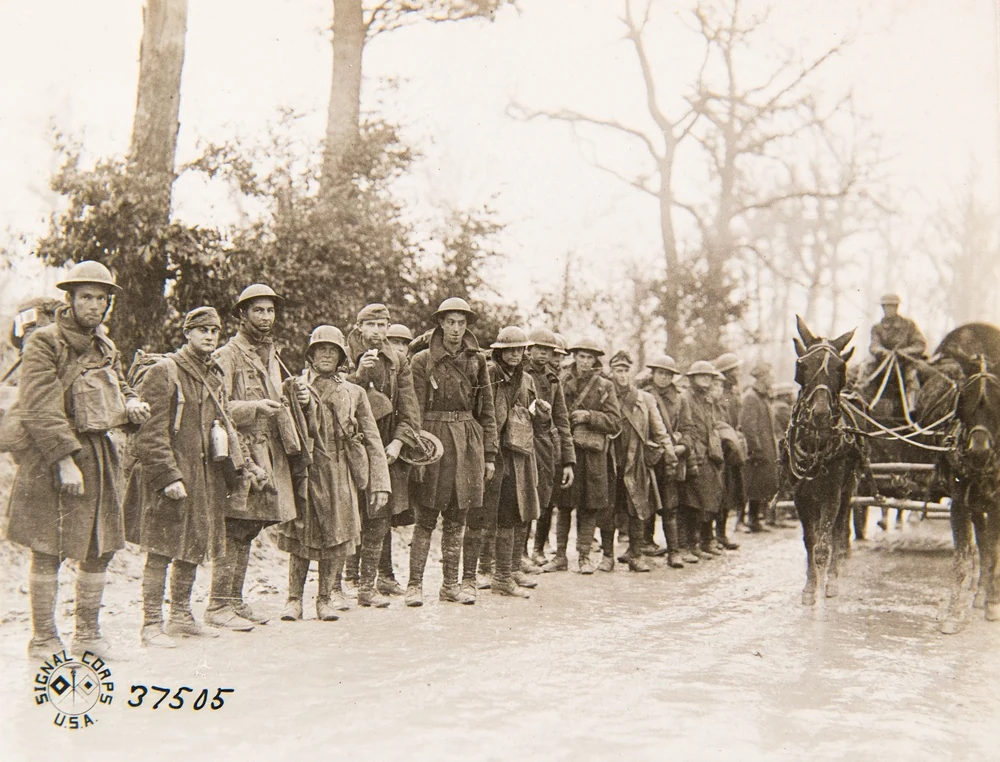
Soldiers of the 64th Infantry Brigade, 32nd Division, move forward in support of the front line near Romagne-sous-Montfaucon, France, on October 18, 1918.
Sgt. 1st Class Frank A. Wallock, U.S. Army Signal Corps, via DVIDS · Public domainHistory
From Sarajevo to a world war
The June 1914 assassination of Archduke Franz Ferdinand and his wife Sophie in Sarajevo set off a diplomatic crisis. Austria-Hungary declared war on Serbia in July. The fighting soon involved Germany, Russia, France, Britain, and their empires, and extended beyond Europe.
The United States stayed neutral until 1917. German submarine attacks on shipping and the disclosure of the Zimmermann Telegram contributed to the decision to enter the war.
Minnesota and the American Expeditionary Forces
In 1917, the Minnesota National Guard’s field artillery regiment was redesignated the 151st Field Artillery and assigned to the 42nd Rainbow Division. It served with the American Expeditionary Forces in France.
The U.S. Army remained segregated. The African American 369th Infantry, known as the Harlem Hellfighters, fought under French command. The French Croix de Guerre recognized soldiers from the regiment for gallantry.
Armistice and remembrance
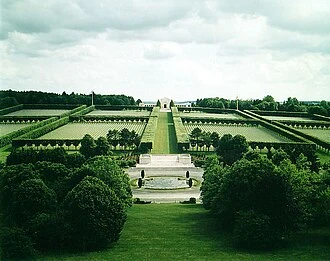
U.S. and Allied forces fought on the Western Front through the final months of 1918. The Meuse–Argonne Offensive began on September 26 and continued until the armistice took effect at 11 a.m. on November 11.
The June 1919 Treaty of Versailles set peace terms with Germany. National Archives records also document the later journeys of Gold Star mothers and widows to the graves of family members in Europe.
Timeline
June–August 1914The Sarajevo assassination and the July crisis
The assassination in Sarajevo triggered a crisis that escalated into declarations of war and mobilizations across Europe.
April 1915 – January 1916The Gallipoli campaign
Allied forces landed on the Gallipoli peninsula in an attempt to open a route through the Dardanelles. Ottoman forces held the peninsula, and the Allies withdrew.
April 6, 1917The United States declares war on Germany
Congress declared war four days after President Woodrow Wilson asked a joint session for a declaration. General John J. Pershing later led the American Expeditionary Forces.
1917–1918Minnesota artillery serves with the Rainbow Division
The 151st Field Artillery joined the 42nd Division and fought in France.
September 26 – November 11, 1918The Meuse–Argonne Offensive
American units attacked between the Argonne Forest and the Meuse River in one of the final offensives on the Western Front.
November 11, 1918The armistice takes effect
Delegates signed the agreement in a railway carriage near Compiègne, France. Fighting on the Western Front stopped at 11 a.m.
June 28, 1919The Treaty of Versailles is signed
The treaty set peace terms with Germany and included the Covenant of the League of Nations.
Images and records
PhotographInfantry advances during the Meuse–Argonne Offensive
Soldiers of the 64th Infantry Brigade, 32nd Division, move forward in support of the front line near Romagne-sous-Montfaucon, France, on October 18, 1918.
Sgt. 1st Class Frank A. Wallock, U.S. Army Signal Corps, via DVIDS · Public domain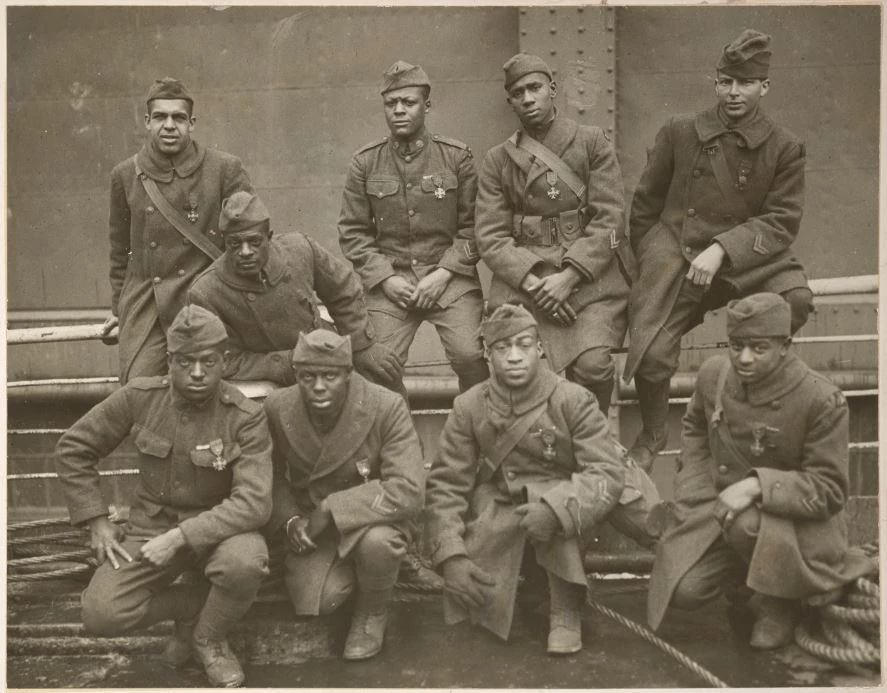
PhotographHarlem Hellfighters return to New York
Nine soldiers of the 369th Infantry wearing the French Croix de Guerre aboard the Stockholm on February 12, 1919.
International Film Service, U.S. National Archives, 165-WW-127A-8 · Public domain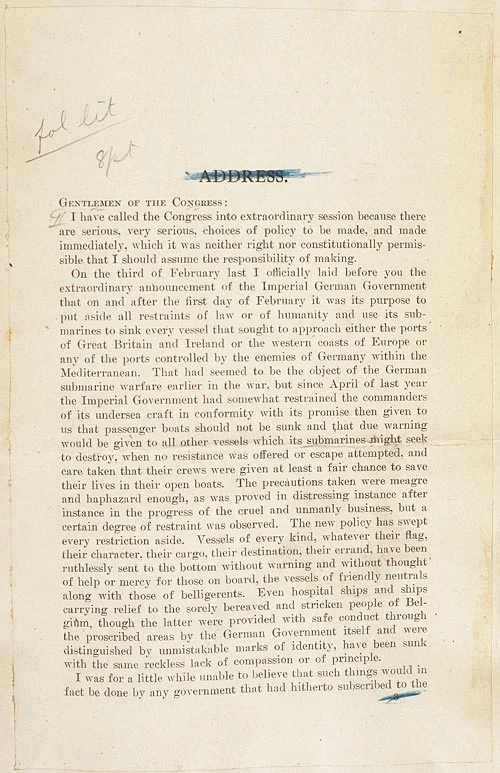
DocumentWilson’s April 2, 1917 address to Congress
President Woodrow Wilson asked Congress for a declaration of war against Germany. The archive provides a transcript and the document pages.
U.S. National Archives, Records of the U.S. Senate · Public domainRelated history


Sources
- Official timeline · Library of Congress A World at War: Timeline, 1914–1921
- Official history · U.S. State Department, Office of the Historian U.S. entry into World War I
- Primary document · U.S. National Archives Wilson’s address requesting a declaration of war
- Archival exhibit · U.S. National Archives On the Battlefield
- Archival guide · U.S. National Archives Records of the American Expeditionary Forces
- Official history · Minnesota National Guard Minnesota National Guard milestones
- Unit history · Minnesota National Guard 1st Battalion, 151st Field Artillery Regiment
- Archival exhibit · U.S. National Archives Photographs of the 369th Infantry and African Americans during World War I
-
Archival photograph · U.S. National Archives
Remembering the nine soldiers in a World War I photograph
International Film Service photograph 165-WW-127A-8, item 26431282, published in 1919.
-
Interactive history · American Battle Monuments Commission
The Meuse–Argonne Offensive
Campaign overview and link to the online interactive.
-
Archival photograph · Defense Visual Information Distribution Service
32nd Division in World War I
U.S. Army Signal Corps, October 18, 1918.
- Primary document · U.S. State Department, Office of the Historian Statement on the signing of the Treaty with Germany
- Official history · U.S. State Department, Office of the Historian Wilson’s Fourteen Points
- Archival history · U.S. National Archives World War I Gold Star Mothers Pilgrimages
- Archival exhibit · U.S. National Archives The Homefront
- Digital exhibit · Library of Congress Echoes of the Great War
Veteran roster
Service references come from the wall inscriptions and approved public profiles.
22 veterans