USS Adirondack (AGC-15)
1945–1955
USS Adirondack was a floating headquarters. Its staffs planned and directed amphibious operations and later coordinated U.S. and NATO naval commands from Naples.
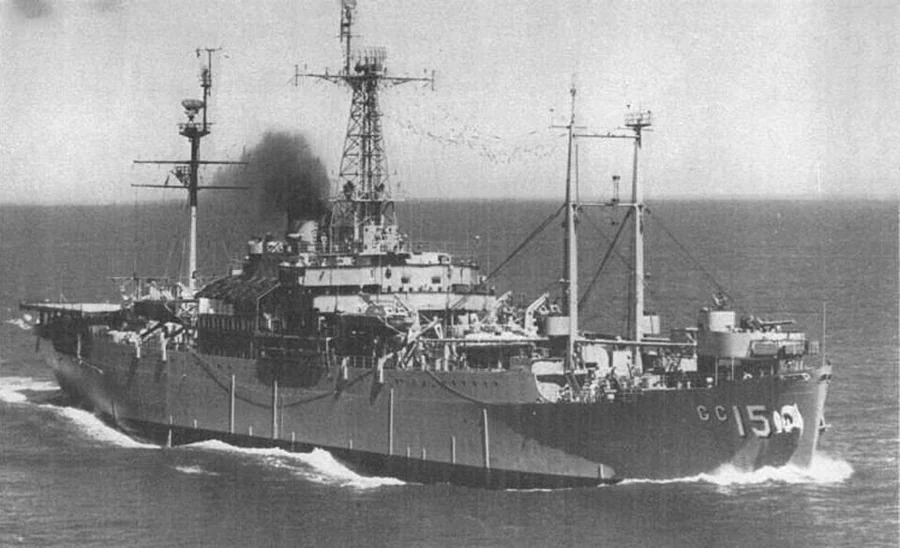
USS Adirondack (AGC-15) underway in the 1950s.
U.S. Navy, public domain · Public domainHistory
From a merchant hull to a command ship
A Maritime Commission hull built at Wilmington, North Carolina, was fitted out at Philadelphia as an amphibious force flagship. Staff spaces, communications equipment and a combat information center let commanders direct landing forces and ships from the same headquarters.
After commissioning on September 2, 1945, Adirondack trained in the Chesapeake Bay and served from Norfolk as flagship of the Operational Development Force. After a period in reserve, it returned to service in 1951 for a new assignment in the Mediterranean.
A NATO headquarters and a landing force flagship
Adirondack reached Naples in August 1951 to serve Allied Forces Southern Europe and U.S. naval commands in the region. Its staff handled the communications and administration needed to support Sixth Fleet operations.
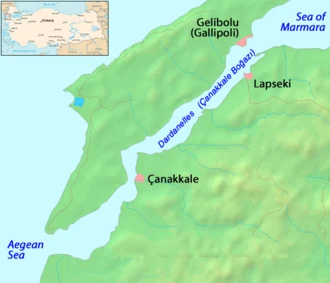
Back in the Atlantic in 1953, the ship led exercises off Puerto Rico and the U.S. coast. In 1954 it supported a NATO landing at Dikili, Turkey, and then tested amphibious equipment and procedures in cold weather at Hamilton Inlet, Labrador.
Timeline
September 2, 1945Commissioned at Philadelphia
The Navy commissioned the converted amphibious headquarters on the day Japan formally surrendered.
1945–1949Operational development at Norfolk
As flagship of the Operational Development Force, the ship supported naval trials and training after the war.
August 18, 1951Arrived at Naples
The command ship carried Allied and U.S. headquarters in the Mediterranean.
March 1954Exercises off Vieques
Adirondack served as Amphibious Group 4 flagship and supported Exercise Sentry Box, which included troops from Puerto Rico.
September 4, 1954NATO landing at Dikili
Marines landed on the Turkish coast in Operation Keystone with Adirondack serving as an amphibious headquarters.
November 1954Cold-weather exercise in Labrador
At Hamilton Inlet, Operation NORAMEX tested landing equipment and doctrine in northern conditions.
November 9, 1955Decommissioned
The ship entered reserve and was struck from the Naval Vessel Register in 1961.
Images and records
PhotographUSS Adirondack (AGC-15) underway in the 1950s
USS Adirondack (AGC-15) underway in the 1950s.
U.S. Navy, public domain · Public domainRelated history






Sources
-
Official Navy photograph collection and ship history, mirror · Naval Historical Center via HyperWar
USS Adirondack (AGC-15), 1945–1972
Confirms November 1955 inactivation. The revised DANFS adds November 9 and the detailed 1954 training movements.
-
Federal vessel status card · U.S. Maritime Administration
Adirondack (AGC-15) status card
Supports later reserve fleet history and disposal.
-
Official historical text, mirror · U.S. Navy historical narrative reproduced by HistoryCentral
Adirondack (AGC-15), ship history
Mirrors the Navy’s revised narrative for the 1954 Sentry Box, Keystone, and Labrador operations and November 9, 1955 reserve date.
Veteran roster
Service references come from the wall inscriptions and approved public profiles.
1 veteran
| Veteran | Rank or rating | Military unit | Service period | Decorations, bases and places |
|---|---|---|---|---|
| Walter Kirchner Jr Photographed face 13 · row 6, position 5 Highlight on the wall | Petty Officer Third Class (U.S. Navy) | USS Adirondack (AGC-15) | — | Korean Peninsula |